If you are searching for wood floor refinishing near me in Littleton, the first decision is not which stain color to choose.
It is:
Does the floor need a recoat, a full refinish, or complete replacement?
For many Littleton homes, replacement is unnecessary.
If the wood is structurally sound, the correct solution is often either:
- Recoat when the finish is dull or lightly scratched but the color and wood are still in good condition
- Refinish when the floor has deep scratches, worn-through finish, discoloration, or you want to change the color
- Replace only when the wood itself is too damaged, too thin to sand safely, structurally unstable, or no longer fits the desired floor design
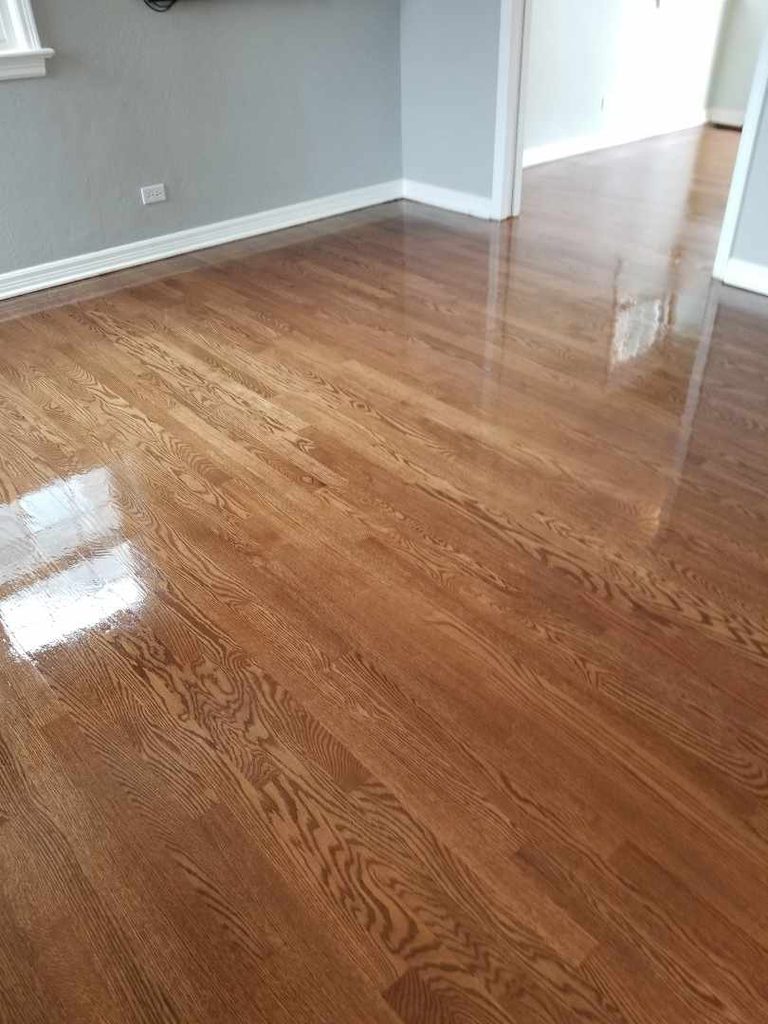
Bona’s current professional guidance makes the same distinction: recoating is appropriate for surface wear and light scratches, while a full refinish is recommended for deeper damage, yellowing, heavy wear, or a major design change.
For Littleton homeowners, knowing the difference can save thousands of dollars and preserve original hardwood that may still have decades of useful life.
Quick Answer: Recoat, Refinish, or Replace?
A simple rule of thumb is:
Recoat if:
- The floor is dull
- Finish has light surface scratches
- There is no exposed bare wood
- You like the existing color
- The coating is still properly bonded
Refinish if:
- Scratches go into the wood
- Finish is worn through
- The floor looks yellow or orange
- You want a different stain color
- There are moderate stains or dents
- The surface looks uneven or heavily worn
Replace if:
- Boards are rotten
- Severe water damage has destroyed the wood
- There is extensive pet damage
- Too little wood remains for another sanding
- Engineered hardwood has an insufficient wear layer
- The homeowner wants a completely different species or plank width
The most expensive option should not automatically be the first option.
What Is a Wood Floor Recoat?
A recoat is sometimes called:
- Screen and recoat
- Buff and coat
- Maintenance coat
The existing floor is not sanded down to bare wood.
Instead, the old finish is cleaned and lightly abraded so a new compatible protective finish can bond to it.
Bona describes recoating as lightly abrading the existing finish and applying a new protective coat to restore appearance and extend floor life.
This makes it much less invasive than full refinishing.
When Is a Recoat the Right Choice?
Recoating works best when the wear is still in the finish layer rather than in the wood.
Good candidates include floors with:
- Light scratches
- Loss of shine
- Minor traffic wear
- Slightly inconsistent sheen
- A finish that still protects the wood
Bona specifically lists surface wear without deep scratching or bare wood exposure as a good recoat candidate.
A recoat can be one of the smartest maintenance decisions a homeowner makes because it renews the protective layer before damage reaches the wood itself.
How Long Does a Recoat Take?
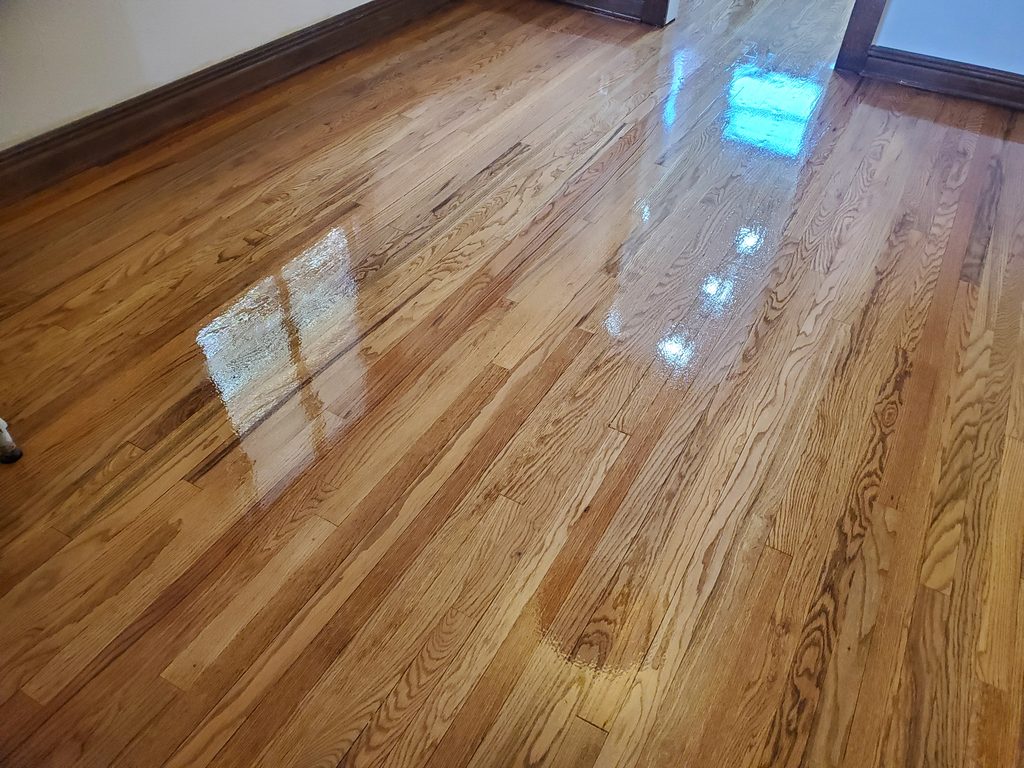
Recoating is significantly faster than full sanding.
Bona’s current homeowner guidance estimates approximately:
1–2 days for a recoat
versus roughly:
3–5 days for full renovation/refinishing, depending on the floor area and project conditions.
Some professional recoat systems can even be completed in a single day on appropriately sized projects.
That means less:
- Dust
- Downtime
- Furniture disruption
- Labor
than a complete refinish.
What Can a Recoat Not Fix?
This is equally important.
A screen and recoat will not normally fix:
- Deep scratches
- Bare wood
- Deep pet stains
- Severe water damage
- Major color changes
- Old stain you want removed
If a homeowner wants to go from dark brown to natural oak, the existing stain needs to be removed.
That requires sanding.
A recoat protects the existing floor.
It does not completely redesign it.
What Is Full Hardwood Floor Refinishing?
Full refinishing removes the old coating and typically the existing stain by sanding the floor.
The process allows the contractor to address:
- Surface wear
- Deep scratches
- Minor dents
- Old stain
- Yellowed finish
- Orange appearance
- Uneven color
Bona describes refinishing as removing the existing finish so the wood can be renewed and, when desired, given a completely different color, sheen, or appearance.
The basic process usually includes:
- Coarse sanding
- Edge sanding
- Progressive finer sanding
- Repairs if necessary
- Final preparation
- Stain or natural sealer
- Protective finish coats
When Is Full Refinishing the Better Choice?
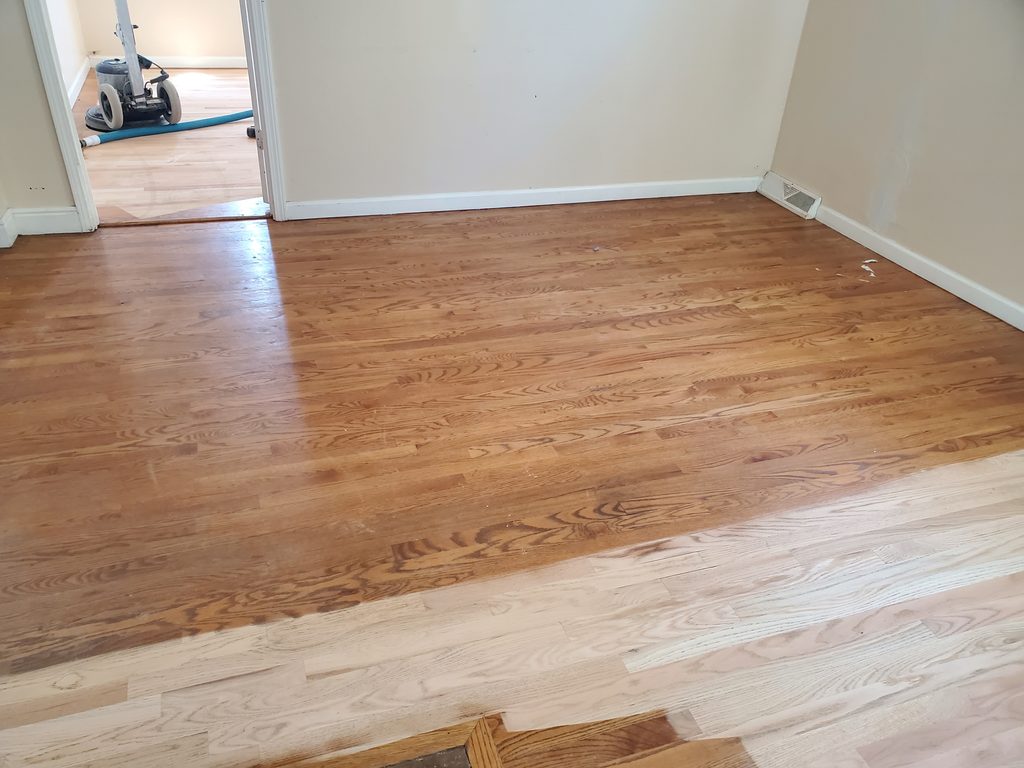
Consider full refinishing when:
- Bare wood is visible
- Scratches penetrate through the finish
- Finish is severely worn
- The floor has turned orange or yellow
- Stains cannot be cleaned away
- You want a major color change
- Different repaired areas need to be blended
Bona specifically identifies severe damage, yellowing, deep scratches, and a lifeless appearance as reasons for a complete refinish.
How Long Does Full Refinishing Take?
A typical project often requires approximately 3–5 working days, although the exact schedule depends on:
- Square footage
- Stain
- Repairs
- Stair work
- Finish system
- Room configuration
Bona’s current comparison similarly gives roughly 3–5 days for a full renovation.
Cure time is separate.
The floor may be dry enough for limited walking before it is ready for rugs, furniture, pets, or normal traffic.
Always follow the exact finish manufacturer’s schedule.
How Much Does Hardwood Floor Refinishing Cost Around Littleton?
Denver-area 2026 data currently places professional hardwood refinishing broadly around:
$3–$8 per square foot.
Angi’s Denver-specific cost data reports this range and estimates professional labor at roughly $2.50–$7 per square foot.
Littleton projects can fall above or below that range depending on:
- Square footage
- Repairs
- Stain
- Stairs
- Furniture moving
- Floor condition
- Room layout
- Finish choice
A straightforward open living area is generally easier to refinish than the same square footage spread through bedrooms, closets, halls, and stairs.
Is Recoating Cheaper Than Refinishing?
Yes, generally.
A recoat uses:
- Less labor
- Less sanding
- Less material
- Less project time
Bona specifically describes recoating as a faster and more cost-effective alternative when full sanding is not yet necessary.
This is why waiting until finish is completely worn through can cost homeowners more.
Maintenance performed early can delay full sanding.
When Should Hardwood Be Replaced Instead?
Hardwood is much more repairable than many homeowners realize.
Bona notes that scraped, scratched, dented, and worn hardwood can often be sanded and refinished and that replacement is rarely necessary solely because of normal surface wear.
Replacement becomes more appropriate when the problem is in the wood structure rather than its surface.
Examples include:
- Extensive rot
- Severe flooding damage
- Major permanent cupping
- Structural movement
- Large areas of pet contamination
- Excessive previous sanding
- Damaged tongue-and-groove system
Floor Thickness Matters
A solid hardwood floor can normally be sanded multiple times during its life.
Bona states that, depending on floor thickness and contractor experience, a wood floor may be sanded approximately four to six times over its lifetime.
But every floor is different.
Before sanding an older Littleton hardwood floor, the contractor should determine how much usable wood remains above the tongue.
This becomes especially important with older floors that may already have been refinished several times.
What About Engineered Hardwood?
Engineered wood requires additional caution.
Some engineered hardwood has a thick real-wood wear layer and can be sanded.
Some has only a very thin veneer.
In those cases, full sanding may damage the product.
A recoat can be particularly valuable because it preserves the limited wear layer.
Bona specifically notes that recoating is gentler on engineered and parquet floors with thinner surface layers.
Never assume engineered hardwood can be sanded simply because the surface is real wood.
Littleton Is a Strong Market for Hardwood Restoration
Littleton has a broader range of housing ages than many newer South Metro communities.
That means local flooring projects often involve:
- Original hardwood
- Older oak
- Previous additions
- Carpet installed over wood
- Different flooring installed at different times
In older homes, replacement should not automatically be the default.
Original hardwood may be an important architectural feature.
A worn floor can often be restored while preserving:
- Existing wood
- Character
- Board dimensions
- Original layout
That can make refinishing particularly attractive in Littleton.
Should You Refinish Original Hardwood in an Older Littleton Home?
Often, yes.
Before removing original hardwood, ask:
- Is the floor solid wood?
- How thick is it?
- Has it been refinished before?
- Are boards stable?
- Is damage localized?
- Can damaged boards be replaced individually?
An old floor with scratches may still be a better floor than a brand-new inexpensive replacement.
Age alone does not determine whether hardwood is finished.
Can Damaged Boards Be Replaced Without Replacing the Entire Floor?
Yes.
Individual damaged boards can often be removed and replaced.
This is useful for:
- Local water damage
- Deep gouges
- Pet damage
- Poor previous repairs
- Missing boards
After replacement, surrounding flooring may be sanded and refinished to blend the repair.
The result is generally much less expensive than replacing an entire room.
What About Water Damage?
Water damage needs to be evaluated before deciding between refinishing and replacement.
Minor localized discoloration may sometimes be sanded out.
More severe moisture can cause:
- Cupping
- Crowning
- Black staining
- Mold
- Rot
Bona specifically notes that standing water can saturate hardwood and cause cupping as the underside absorbs more moisture than the top.
The source of moisture needs to be corrected first.
Never refinish a floor while an active moisture problem remains.
What About Pet Stains?
Pet damage varies widely.
Light surface discoloration may improve substantially during sanding.
Deep urine contamination can penetrate:
- Finish
- Wood fibers
- Board joints
- Subfloor
Some individual boards may need replacement.
In severe cases, the subfloor also needs treatment or repair.
Do not assume that sanding always removes pet odor.
The floor needs to be evaluated first.
Can an Orange or Yellow Littleton Floor Be Refinished?
Yes.
This is one of the most common reasons homeowners refinish older oak.
Yellow or orange appearance can come from:
- Old oil-modified finish
- Golden stain
- Red oak undertones
- UV aging
Full sanding removes the old surface coating and stain.
Then the homeowner can choose a more current appearance.
Popular directions include:
- Natural oak
- Light neutral
- Honey
- Warm beige
- Medium brown
- White-oak-inspired colors
If the color itself is the problem, a recoat usually is not enough because it leaves the existing stain in place.
Current Hardwood Trends in Colorado
Current hardwood trends strongly support refinishing rather than automatically replacing older wood.
The National Wood Flooring Association’s 2026 industry outlook reports growing demand for:
- Natural wood tones
- Light colors
- Brown colors
- Longer boards
- Wider boards
- White oak
- Matte finishes
while demand for gray and red tones continues to decline.
This is particularly relevant to homeowners with orange or gray floors from previous design cycles.
Many existing oak floors can be updated toward current color trends without replacement.
Matte or Satin?
For most current refinishing projects, matte and satin remain strong choices.
Matte provides:
- Natural appearance
- Minimal glare
- Better camouflage of small scratches
Satin provides:
- Slight reflection
- Traditional hardwood depth
- Practical everyday appearance
For active households with children or dogs, both are generally easier to live with than high gloss.
Hardwood Trends in Littleton
Littleton’s older housing stock makes restoration especially important.
The most appropriate look does not always need to copy the newest Castle Rock remodel.
For many Littleton homes, attractive refinishing directions include:
- Natural oak
- Medium natural brown
- Honey
- Warm walnut
- Satin finish
- Matte finish
These colors update older hardwood while still fitting the character of the home.
Hardwood Trends in Highlands Ranch
Highlands Ranch contains many homes from the 1980s, 1990s, and early 2000s.
Those houses often have oak floors that are structurally good but visually dated.
Common updates include:
- Removing orange polyurethane
- Lightening dark stain
- Switching from gloss to satin
- Expanding hardwood into formerly carpeted areas
Where existing flooring remains good, refinishing can create a major visual update without replacing the material.
Hardwood Trends in Centennial
Centennial also has a large amount of traditional oak.
A popular strategy is to preserve the existing floor while moving away from:
- Heavy orange
- Strong red
- Cool gray
toward:
- Natural
- Neutral brown
- Honey
- Medium brown
The important point is that stain should work with the wood species.
Red oak should not automatically be treated as though it were white oak.
Hardwood Trends in Castle Rock
Castle Rock is one of the strongest local markets for natural wide-plank white oak.
The national trend toward wider and lighter hardwood also appears in NWFA’s 2026 outlook.
Existing narrow-strip hardwood cannot be converted into wide plank through refinishing.
But homeowners can borrow the same aesthetic direction:
- Natural color
- Light warm tones
- Matte finish
- Less orange
without replacing perfectly usable wood.
Hardwood Trends in Parker
Parker homeowners often need floors that work for:
- Dogs
- Children
- Heavy traffic
Natural and medium colors are practical because they tend to show scratches, pet hair, and dust less aggressively than very dark floors.
Matte and satin finishes also fit this lifestyle well.
Hardwood Trends in Lone Tree
Lone Tree homes often have larger open-plan interiors.
Large continuous hardwood areas make color and sheen especially important.
Current natural and white-oak-inspired tones can make these spaces feel lighter and more contemporary.
If an existing floor is structurally sound, refinishing it in a lighter direction can sometimes achieve much of that effect at far lower cost than replacement.
Hardwood Trends in Denver
Denver’s older housing stock makes wood restoration especially relevant.
Many properties contain hardwood that has been covered, repaired, or refinished multiple times.
The best solution should account for the house itself rather than simply following a trend.
Original hardwood that can be restored often remains an asset.
Recoat vs. Refinish: The Scratch Test
A practical way to think about scratches is:
Scratch appears only in the clear coating
Consider recoat.
Scratch penetrates into the wood
Consider full refinishing.
Board itself is broken or deeply damaged
Consider board repair or replacement, potentially followed by refinishing.
Do not choose full sanding automatically when surface maintenance would solve the problem.
Every sanding removes some wood.
Why Recoating Before Bare Wood Appears Is Smart
A floor finish is designed to protect the wood.
If traffic wears completely through the coating, dirt and moisture can enter the wood fibers.
At that point, full refinishing becomes more likely.
Recoating earlier adds another protective wear layer and can extend the time between full sanding cycles.
Bona states that recoating can extend finish life by several years while removing minimal material from the existing floor.
That is especially valuable for engineered hardwood or older solid flooring with limited remaining thickness.
What About Deep Cleaning Instead?
Sometimes a floor looks worse than it actually is.
Built-up:
- Dirt
- Cleaning residue
- Grease
- Scuffing
can make the floor look dull.
Bona’s renovation system distinguishes professional deep cleaning from both recoating and refinishing.
If the finish itself is still healthy, deep cleaning may be enough.
That is why inspection should come before sanding.
How to Tell if the Existing Finish Will Accept a Recoat
Compatibility matters.
The new finish needs to bond to the existing coating.
Problems may occur if homeowners have previously applied:
- Wax
- Oil soap
- Acrylic polish
- Certain rejuvenators
- Contaminating cleaning products
The contractor may need to test adhesion before proceeding.
Applying new finish over an incompatible surface can lead to peeling or delamination.
Should You Recoat a Prefinished Hardwood Floor?
Possibly.
A factory-finished floor can sometimes be recoated.
The challenge is that many prefinished floors have:
- Aluminum oxide coatings
- Beveled edges
- Specialized factory finishes
The contractor needs to use a preparation system compatible with the existing coating.
One benefit of recoating is that it preserves bevels and textures that can be reduced or eliminated by full sanding. Bona specifically identifies preservation of beveled details as a recoat advantage.
Can Prefinished Hardwood Be Fully Refinished?
Sometimes.
Solid prefinished hardwood usually provides more sanding potential than thin engineered flooring.
But aggressive sanding can remove:
- Bevels
- Texture
- Factory character
That may be desirable if the homeowner wants a site-finished appearance.
It should simply be understood before work begins.
What Should a Professional Evaluation Include?
Before recommending recoat, refinish, or replacement, the contractor should evaluate:
- Wood species
- Solid vs. engineered construction
- Remaining wear layer
- Finish condition
- Bare wood exposure
- Deep scratches
- Pet stains
- Water damage
- Movement
- Gaps
- Previous coatings
- Desired final appearance
That is more useful than quoting one service before seeing the floor.
What Should Be Included in a Refinishing Quote?
A useful estimate should explain:
- Approximate square footage
- Sanding level
- Repair work
- Stain
- Finish product
- Number of finish coats
- Stairs
- Furniture requirements
- Cleanup
- Schedule
Current Denver pricing ranges are broad enough that two contractors can quote very different numbers while actually proposing different work.
Compare scope, not only price.
Questions to Ask a Wood Floor Contractor in Littleton
When searching for wood floor refinishing near me in Littleton, ask:
- Does this floor actually need sanding?
- Would a recoat work?
- Is any bare wood exposed?
- Can damaged boards be repaired?
- How much wood remains above the tongue?
- Is this solid or engineered hardwood?
- Can the existing color be changed?
- What finish will you use?
- How many coats are included?
- When can furniture return?
- How do you handle Colorado seasonal gaps?
A knowledgeable contractor should be willing to recommend the least invasive service that correctly solves the problem.
Our Professional Recommendation
For most Littleton homeowners, the decision should follow this order:
Preserve first. Sand when necessary. Replace only when justified.
If the existing floor still has a healthy protective layer and only light wear, recoat it.
If the finish is worn through, scratches are deep, or the color needs to change, refinish it.
If the wood itself is structurally damaged or cannot safely be restored, replace it.
For homeowners who want an evaluation of which option actually makes sense, Dream Flooring LLC — (303) 330-0575 provides wood floor recoating, sanding, refinishing, repairs, and installation throughout Littleton and Denver Metro.
Final Answer: Recoat, Refinish, or Replace Wood Floors in Littleton?
Recoat when the damage is primarily in the finish. Refinish when damage or unwanted color reaches deeper. Replace only when the wood itself cannot reasonably be restored or the homeowner wants a fundamentally different floor.
A recoat is best for:
- Dullness
- Light scratches
- Surface wear
- Healthy wood underneath
It can typically be completed much faster than full sanding and helps extend the life of the existing floor.
A full refinish is best for:
- Deep scratches
- Bare wood
- Old yellow or orange finish
- Major color changes
- Moderate stains and wear
Bona specifically identifies full refinishing as the appropriate renovation when floors have severe wear, yellowing, deep scratches, or need a completely new appearance.
Replacement should generally be reserved for:
- Severe structural damage
- Rot
- Extensive moisture damage
- Major contamination
- Insufficient remaining hardwood
- A desired change in species or plank dimensions
Current flooring trends make restoration especially attractive. The 2026 NWFA outlook shows increasing demand for natural tones, lighter colors, brown tones, wider boards, white oak, and matte finishes, while gray and red-toned flooring continue to decline.
For many Littleton homes, you do not need to throw away an old hardwood floor to get a modern-looking floor.
You need to determine how much intervention the existing wood actually needs.