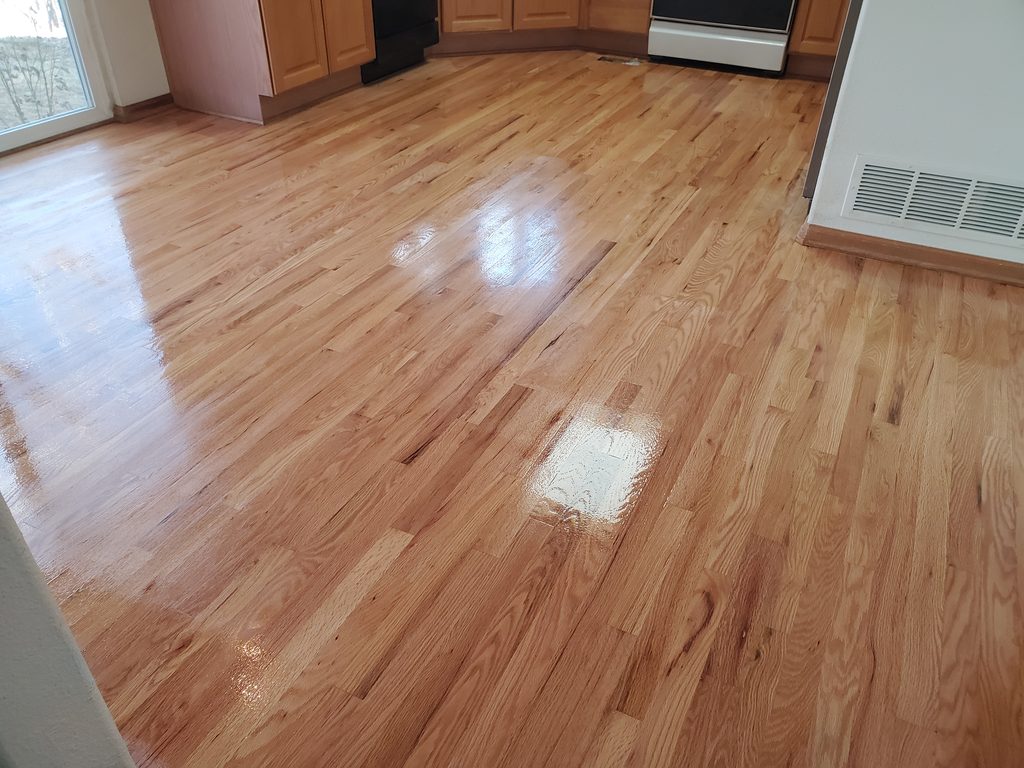
Yes, sometimes you can live in a house while hardwood floors are being refinished — but it depends on which floors are being worked on, the products being used, ventilation, access to bedrooms and bathrooms, and whether children or pets are in the home.
If only one isolated room is being refinished and the rest of the house can be completely separated from the work area, staying home may be practical.
If the entire main floor, stairs, hallways, or most of the house are being sanded, stained, and finished, staying elsewhere for part of the project is usually much easier.
The biggest issues are not just odor. Homeowners need to consider:
- Sanding dust
- VOCs and finish vapors
- Access through wet flooring
- Drying and curing time
- Children and pets
- Ventilation
- Furniture storage
- Whether bedrooms and bathrooms remain accessible
The correct answer is therefore:
You may be able to stay in the house during part of a hardwood refinishing project, but there are stages when leaving the house may be the safer and more practical choice.
What Happens During Hardwood Floor Refinishing?
Understanding the process helps explain why living in the house can be difficult.
A typical hardwood refinishing project includes:
- Removing furniture
- Repairing damaged boards
- Sanding off the old finish
- Edge and corner sanding
- Final floor preparation
- Thorough dust removal
- Applying stain, if desired
- Applying sealer or finish
- Applying additional finish coats
- Allowing the floor to dry and cure
Different stages create different problems for homeowners.
During sanding, dust and noise are the main concerns.
During staining and finishing, access, odors, VOCs, ventilation, and drying time become more important.
Can You Stay Home While the Floors Are Being Sanded?
Sometimes.
Modern professional sanding equipment with good dust containment can dramatically reduce airborne dust compared with older sanding methods.
But hardwood sanding is still construction work.
There will typically be:
- Noise
- Equipment
- Some dust
- Extension cords and hoses
- Workers moving equipment between rooms
- Areas you cannot enter
The EPA recommends containing remodeling dust and separating work areas from occupied parts of the house. Exhaust ventilation and physical barriers can also help prevent contaminants from spreading into living areas.
If one bedroom is being refinished while the rest of the house is separated by doors, remaining home can be realistic.
If your entire first floor is being sanded, the situation is very different.
Can You Walk Through Rooms While They Are Being Refinished?
Usually not.
This is one of the biggest practical problems homeowners underestimate.
Imagine that your hardwood runs continuously through:
- The front entrance
- Kitchen
- Living room
- Hallway
- Stair landing
Once stain or finish is applied, those areas may become temporarily inaccessible.
You cannot simply walk across wet polyurethane because you need to reach the refrigerator.
Before the project begins, you need to determine:
How will everyone get in and out of the house?
Can bedrooms still be reached?
Can bathrooms still be reached?
Can you reach the kitchen?
Can pets get outside without crossing the floor?
Sometimes the floor plan, rather than the fumes, is what makes temporary relocation necessary.
Can You Stay in the House During Staining?
This depends heavily on the stain.
Traditional solvent-based stains may produce substantial odor and VOC emissions while drying.
EPA guidance recommends good ventilation when renovation products emit pollutants and recommends keeping occupants — particularly children — away from active work areas.
If a large portion of the house has been stained with a solvent-based product, we generally would not plan on treating the house as normal living space that evening.
A small isolated area is different from staining 1,500 square feet of connected hardwood.
The larger the treated area, the more important ventilation and temporary separation become.
What About Water-Based Finishes?
Modern professional waterborne finishes have made hardwood refinishing much more convenient.
They generally offer:
- Lower odor than traditional solvent-heavy systems
- Faster drying
- Faster recoating
- Faster return to use
- Clearer appearance
- Less ambering
This is one reason these finishes are popular for today’s natural hardwood look.
However:
Water-based does not mean “no emissions,” and low odor does not mean you can ignore ventilation.
Follow the exact manufacturer’s technical and safety instructions for the products being used.
Oil-Based vs. Water-Based: Which Is Easier to Live With?
For homeowners trying to remain in the house, professional waterborne finish systems are generally easier to manage.
Traditional oil-based polyurethane typically produces a stronger odor and requires longer drying periods.
That can make living in the house substantially less comfortable.
Oil-based finishes still have applications, especially when a homeowner wants the warmer appearance they can produce.
But when minimizing downtime and odor is important, waterborne systems are often preferable.
Do You Need to Leave the House Completely?
Not necessarily.
There are three common situations.
Situation 1: One Isolated Room
You may be able to stay home.
If the refinished room can be closed off and ventilated without blocking important areas of the house, the disruption can be relatively minor.
Situation 2: Most of One Floor
It becomes much more difficult.
If the kitchen, living room, hallways, and entrances are all involved, staying home may technically be possible but extremely inconvenient.
Situation 3: Entire House or Stairs
Temporary relocation often makes sense.
If hardwood stairs are being refinished, they may temporarily prevent access between floors.
For a two-story home, that can make normal occupancy almost impossible.
Can You Sleep Upstairs While Downstairs Floors Are Being Refinished?
Possibly.
But an upstairs bedroom does not automatically mean you are isolated from the work.
Air can travel through:
- Open staircases
- HVAC systems
- Door gaps
- Return-air ducts
- Large open floor plans
If fumes from the first floor are clearly noticeable upstairs, then the spaces are not effectively separated.
EPA renovation guidance recommends isolating pollutant-producing work areas and using exhaust ventilation to move contaminants outdoors rather than simply redistributing indoor air.
For a large staining or finishing project, sleeping elsewhere during the highest-odor stage can be the more practical option.
What About Children?
Children should not be playing around an active hardwood refinishing project.
There are multiple reasons:
- Dust
- Equipment
- Electrical cords
- Wet coatings
- Finish vapors
- Restricted access
EPA remodeling guidance specifically recommends protecting occupants, especially children, from odors and pollutants and keeping them away from the work area.
Even when adults decide to remain in another section of the house, families with young children may find temporary relocation much easier.
What About Dogs and Cats?
Pets make staying home during refinishing significantly more complicated.
A dog does not understand:
“Don’t walk into the living room for the next 24 hours.”
Pets can:
- Walk onto wet finish
- Leave paw prints
- Introduce hair into the coating
- Scratch partially cured finish
- Cross containment barriers
- Be exposed to fumes close to floor level
For homes with dogs or cats, arranging temporary care during critical parts of the project is often worthwhile.
This protects both the animal and the finished floor.
How Long Do You Need to Stay Off Refinished Floors?
There is no universal answer.
It depends on the finish system.
Homeowners should distinguish between four different terms:
Dry to Touch
The surface feels dry.
Ready for Recoat
Another coat can be applied.
Ready for Light Foot Traffic
The manufacturer allows careful walking.
Fully Cured
The coating has reached its intended final performance.
These are not the same.
A floor may support careful foot traffic while still being vulnerable to furniture, rugs, pets, or heavy use.
Always follow the manufacturer’s requirements for the exact product installed.
Can You Move Furniture Back Immediately?
Usually not.
Furniture concentrates much more pressure on the finish than a person walking across it.
Returning heavy furniture too early can:
- Dent finish
- Leave marks
- Create impressions
- Scratch partially cured coatings
When furniture returns:
- Lift rather than drag it
- Use clean felt pads
- Follow manufacturer cure times
- Avoid immediately covering large areas with rugs
Planning where furniture will be stored is an important part of living through a refinishing project.
What About the Kitchen?
The kitchen is often what makes remaining in the house impractical.
Many Denver-area homes have hardwood continuously running through:
kitchen → dining room → living room → hallway
Once that entire floor is being finished, homeowners may lose access to:
- Refrigerator
- Stove
- Pantry
- Sink
- Main entrance
Before work begins, consider creating a temporary food area elsewhere with:
- Mini refrigerator
- Coffee maker
- Microwave
- Bottled water
- Disposable dishes
This is much easier than discovering halfway through the job that you cannot reach the refrigerator without crossing wet finish.
Ventilation Is Extremely Important
Opening windows can help, but good ventilation means more than simply moving indoor air around.
EPA guidance recommends exhausting polluted air directly outdoors during remodeling. An exhaust fan blowing from the work area to the outside can both remove pollutants and help prevent them from moving to other sections of the home.
EPA guidance also recommends continuing strong ventilation after finishes and other materials that may off-gas have been applied, with a typical recommendation of maximum ventilation during the work and for at least 72 hours afterward.
That does not mean every family must leave the house for exactly 72 hours.
It means ventilation should continue while emissions decline.
Does Running the HVAC Solve the Problem?
Not necessarily.
Recirculating air is not the same as exhausting contaminants.
In some layouts, an HVAC return near the work area can distribute odors to bedrooms and other parts of the house.
The ventilation strategy should be discussed before finishing begins.
Direct exhaust to the exterior can be more useful than simply circulating the same indoor air throughout the house.
Colorado Weather Creates an Extra Challenge
Living through hardwood refinishing can be particularly interesting in Colorado.
Opening several windows is easy on a pleasant September afternoon.
It is much less appealing when it is:
- 20°F outside
- Snowing
- Extremely windy
- Very hot
- Smoky outside
Still, indoor conditions cannot simply be ignored.
Temperature, humidity, and airflow affect how finishing products dry and cure.
A professional contractor should follow the environmental requirements of the exact finish system being used.
Colorado’s Dry Climate Also Affects the Wood
Wood naturally changes dimension as moisture levels change.
Colorado’s dry winters can create visible seasonal gaps.
Those gaps do not necessarily mean the flooring has failed.
A contractor should distinguish normal seasonal movement from:
- Moisture damage
- Installation problems
- Permanent shrinkage
- Structural issues
This expertise matters when determining what actually needs repair during refinishing.
How Long Does a Typical Refinishing Project Take?
For roughly 1,000 square feet, a professional refinishing project often takes approximately 3–5 days, depending on:
- Floor condition
- Layout
- Repairs
- Stain
- Product system
- Stairs
- Number of rooms
Large projects or floors requiring extensive repairs can take longer.
Importantly:
You may not need to be out of the house for the entire 3–5 days.
For example, homeowners may be able to stay during the early sanding stage but choose to stay elsewhere after stain or finish is applied.
That is often more practical than moving out for the entire project.
The Best Strategy: Plan the Refinishing Sequence Around the House
Professional project planning can sometimes allow homeowners to remain partially in the house.
Possible strategies include:
- Completing floors in stages
- Maintaining access to one exterior door
- Keeping one bathroom accessible
- Refinishing upstairs and downstairs separately
- Scheduling stairs carefully
- Creating an alternate route when possible
However, dividing a continuous hardwood area into separate stages is not always a good idea.
Stain and finish transitions can sometimes become visible.
A contractor should prioritize the quality of the finished floor rather than creating a complicated schedule simply so someone can walk through the work area every evening.
Should You Refinish Floors Room by Room?
It sounds convenient, but not always.
If several rooms contain continuous hardwood without natural transition points, finishing one room this week and another later may create:
- Color differences
- Sheen differences
- Lap lines
- Visible transitions
Continuous flooring often looks best when refinished as one continuous project.
Doorways or existing flooring transitions can make staged work easier.
The layout should be evaluated first.
Current Hardwood Flooring Trends in Colorado
Current 2026 wood flooring trends actually make today’s refinishing projects somewhat different from those of ten years ago.
The National Wood Flooring Association reports strong consumer demand for:
- Natural tones
- Light colors
- Longer and wider boards
- Engineered wood
- White oak
It also reports declining demand for gray and red color tones and increasing interest in brown colors. Matte finishes remain particularly popular.
For homeowners refinishing existing floors, that means popular looks currently include:
- Natural oak
- Warm beige
- Honey
- Light-medium brown
- Caramel
- Warm neutral tones
- Matte finishes
- Satin finishes
These trends can often be achieved by restoring existing hardwood rather than replacing it.
Denver Hardwood Trends
Denver homeowners are increasingly favoring floors that show the natural wood rather than covering it with very dark or gray stain.
Natural oak, warm brown, white-oak-inspired colors, and lower-sheen finishes work well with both contemporary remodels and many of Denver’s older homes.
Existing oak flooring often has significant value.
An older floor that looks orange or glossy may simply need updated sanding, color, and finish rather than replacement.
Highlands Ranch
For Highlands Ranch’s open-plan homes, large continuous hardwood areas make project planning especially important.
A kitchen, dining area, living room, and hallway may all need to be completed together.
That can make remaining home more difficult, but it also creates an excellent finished result when the entire level receives one consistent natural or warm stain and a satin or matte finish.
Local 2026 reporting also notes that homeowners in Highlands Ranch are choosing noticeably different flooring looks than they did several years ago as wider and more natural styles gain popularity.
Castle Rock and Castle Pines
Castle Rock is one of the clearest examples of the current wide-plank trend.
A 2026 local flooring report says white oak planks nine inches and wider in natural matte finishes are dominating many current orders and account for about 40% of that company’s hardwood projects.
If an existing home already has quality narrow oak, however, replacement is not always necessary.
Refinishing can still bring the floor much closer to today’s look through:
- Natural color
- Warm neutral stain
- Reduced orange tone
- Matte or satin finish
Board width cannot be changed, but color and sheen can transform the appearance.
Parker
For Parker homes, durability often matters as much as appearance.
Families with pets and children may benefit from:
- Natural or medium colors
- Matte or satin sheen
- Durable professional finish systems
These finishes also tend to hide daily scratches and dust better than dark high-gloss floors.
From an occupancy standpoint, homes with dogs require more careful planning because keeping pets away from newly finished large open areas can be difficult.
Centennial
Centennial has many existing oak floors where replacement may be unnecessary.
Older red oak can often be refinished into:
- Natural
- Honey
- Warm neutral
- Medium brown
- Carefully selected greige
If the homeowner is updating a large connected main floor, it may make sense to stay elsewhere during the finishing portion rather than attempting to divide the continuous surface into multiple small projects.
Littleton
Littleton’s mix of older and newer homes means hardwood refinishing projects vary considerably.
Older homes may have:
- Original narrow oak
- Previous repairs
- Small rooms
- Multiple doorways
Those layouts sometimes make sections easier to isolate during construction.
At the same time, original hardwood can be worth preserving rather than covering or replacing.
Warm natural finishes can update the wood while preserving the character of the house.
Lone Tree
Lone Tree’s larger open floor plans work particularly well with today’s natural, low-sheen flooring trends.
But large continuous hardwood areas also create a practical issue:
There may be nowhere to walk once the finish is applied.
For these homes, staying somewhere else during the final finishing stage can often be much easier than trying to maintain a route through a large wet floor.
When We Recommend Staying Somewhere Else
Even when technically possible to remain home, temporary relocation often makes sense when:
- Almost the entire main floor is being refinished
- Stairs are included
- Bedrooms cannot be reached without crossing work areas
- Solvent-heavy products are being used
- Children are present
- Pets cannot be isolated
- Someone is particularly sensitive to odors
- Ventilation options are limited
- The kitchen and bathrooms become inaccessible
The goal should not be to prove that you can survive inside the house during construction.
The goal is to protect the occupants and give the flooring crew the conditions needed to produce a good floor.
Questions to Ask Your Contractor Before Refinishing Starts
Before deciding whether to stay home, ask:
- Which rooms will be inaccessible?
- Which entrance can we use?
- Can we reach the bathrooms?
- Can we reach the bedrooms?
- What stain will be used?
- What finish will be used?
- Is the finish water-based or oil-based?
- What ventilation is required?
- When is light foot traffic allowed?
- When can pets return?
- When can furniture return?
- When can rugs return?
- When is the finish fully cured?
A contractor should be able to explain the sequence before sanding starts.
If the answer is simply:
“Don’t worry, it’ll be fine,”
that is not enough information for planning a multi-day refinishing project.
Our Professional Recommendation
For homeowners asking “Can you live in a house while refinishing floors?”, the answer is:
Yes, sometimes — but do not assume you can use the house normally.
If only a small isolated section is being refinished, remaining home may be easy.
If the project includes most of the first floor, stairs, entrances, or large continuous hardwood areas, staying elsewhere during the stain and finish stages is often the better plan.
Product choice also matters. Modern professional waterborne finishes can significantly reduce odor and project downtime compared with some traditional systems, but proper ventilation and manufacturer instructions still need to be followed.
For Denver Metro homeowners planning a project, Dream Flooring LLC — (303) 330-0575 provides hardwood floor sanding, staining, refinishing, repair, buff & coat, and installation services.
Final Answer: Can You Live in a House While Refinishing Floors?
Yes, but whether you should depends on the size and layout of the project.
You can often stay home when:
- Only one isolated area is being refinished
- Bedrooms and bathrooms remain accessible
- The work area can be properly separated
- Good ventilation is available
Consider staying elsewhere when:
- Most of the house is being refinished
- Stairs are involved
- You cannot reach essential rooms
- Strong solvent odors are present
- Children or pets cannot be kept away
- Ventilation is inadequate
And remember that the project does not end when the floor looks dry.
Dry, walkable, and fully cured are three different things.
The best refinishing plan considers not only how the floor will look when finished, but also how the family can safely and realistically use the house while the work is being completed.