For 1,000 square feet of hardwood flooring, a professional full refinishing project usually takes about 3 to 5 days.
That includes sanding, edge work, cleaning, stain if requested, and application of the protective finish. The exact schedule depends on the condition of the floor, number of rooms, repairs, stain color, finish system, drying conditions, stairs, closets, and how much detail work is required.
For a straightforward open-floor-plan project with no major repairs, about 4 days is a realistic planning estimate.
However, homeowners should understand one important distinction:
The job being finished does not necessarily mean the floor is fully cured.
Some professional water-based finishes dry quickly enough for recoating within a few hours, but the floor may still need additional curing time before rugs, heavy furniture, pets, and normal use return.
Typical Timeline for Refinishing 1,000 Sq. Ft.
A common professional schedule may look like this:
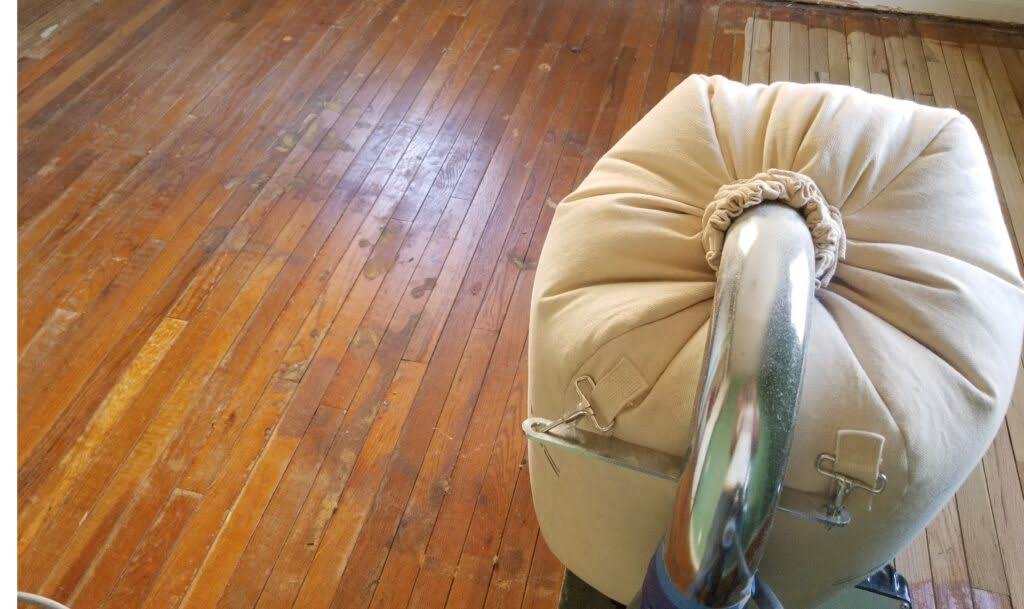
Day 1: Sanding
The first day is usually dedicated to removing the old finish and leveling the floor.
This can include:
- Drum or belt sanding
- Edge sanding
- Corner work
- Sanding closets
- Removing old stain and finish
- Correcting light surface damage
- Initial board repairs
A relatively open 1,000-square-foot floor can move quickly.
A house divided into many bedrooms, narrow hallways, closets, and small spaces takes longer because much more edge work is required.
Day 2: Final Sanding, Preparation, and Stain
The floor is progressively sanded with finer abrasives until the surface is ready for finishing.
Then the floor must be thoroughly vacuumed and cleaned.
If the homeowner chooses a stain, this is typically when it is applied.
Stain can add time because the floor must dry sufficiently before the next product is applied.
Darker stains may also require more careful preparation because sanding marks and application inconsistencies become easier to see.
Day 3: Sealer and Finish
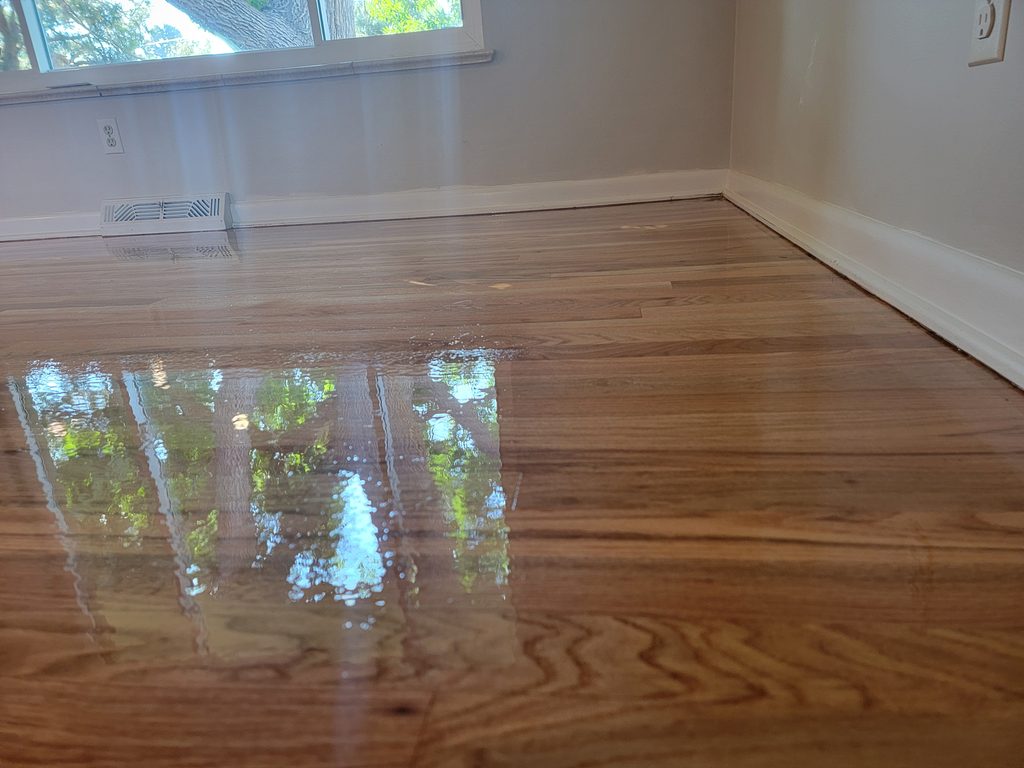
Depending on the refinishing system, the contractor may apply:
- Sealer
- First finish coat
- Additional finish coats
Many professional water-based finishes can be recoated within approximately 2–3 hours under proper temperature and humidity conditions.
For example, Bona’s current technical data for Traffic HD lists a 2–3 hour drying time between coats under recommended conditions.
Day 4: Additional Coats and Final Inspection
If additional finish coats are required, they may be applied on the fourth day.
The contractor will also inspect the floor for consistency and make sure the final finish has dried properly.
For many standard 1,000-square-foot residential projects, this is when the actual refinishing work is completed.
Why Some 1,000 Sq. Ft. Floors Take 3 Days and Others Take 6
Square footage is only part of the equation.
We do not estimate refinishing time based only on the number of square feet.
Two houses with exactly 1,000 square feet of hardwood may require very different amounts of work.
Open Floor Plan
A large living room, kitchen, and dining area connected together can often be sanded more efficiently.
There are fewer edges, doorways, closets, and transitions.
Many Small Rooms
A house with several bedrooms, closets, narrow hallways, and multiple doorways requires much more hand and edge sanding.
That can add significant labor even though the total square footage is identical.
Floor Condition Makes a Big Difference
A lightly worn floor is easier to refinish than one with:
- Deep scratches
- Uneven previous sanding
- Pet stains
- Water damage
- Loose boards
- Gaps requiring repair
- Heavy old coatings
- Paint or adhesive
- Multiple layers of old finish
Board replacement also adds time because the repaired areas must be fitted and blended into the surrounding floor before final sanding.
Does Staining Add Time?
Usually, yes.
If you choose a natural finish with no stain, the refinishing schedule can often be shorter.
When stain is added, the contractor needs time to:
- Finish sanding
- Clean the floor
- Apply stain
- Allow the stain to dry
- Confirm that the stain is ready for the finishing system
Temperature, ventilation, humidity, wood species, and stain color can all affect drying time.
A dark stain should never be rushed simply to save a few hours.
Water-Based vs. Oil-Based Finish: Which Is Faster?
This can dramatically affect the project schedule.
Water-Based Finish
Modern professional water-based finishes generally allow much faster recoating and return to service.
For example, Bona Traffic HD currently lists:
- 2–3 hours between coats
- Approximately 80% cure after one day
- Approximately 100% cure after three days
- Walking allowed after approximately 24 hours under its U.S. technical guidance
LOBA 2K Supra A.T. similarly lists recoating after approximately 2–3 hours and full cure in approximately three days under recommended conditions.
This is one reason professional water-based systems are attractive when homeowners want to minimize downtime.
Oil-Based Finish
Traditional oil-based polyurethane generally dries more slowly.
Each coat may require substantially more drying time, so the overall refinishing project can extend beyond the typical water-based timeline.
The appearance is also different: oil-based finishes tend to add more warmth and amber color, while modern water-based finishes generally remain clearer.
When Can You Walk on the Floor?
This depends on the exact finish used.
A common mistake is assuming:
“Dry to the touch = fully cured.”
That is not true.
Many finishes allow light foot traffic before they reach full chemical cure.
With Bona Traffic HD, for example, the current U.S. technical sheet says the floor may be walked on after approximately 24 hours but remains more susceptible to damage until curing is complete.
Always follow the exact manufacturer’s recommendations for the product actually applied.
When Can Furniture Go Back?
The safest answer is:
follow the finish manufacturer’s curing instructions and your contractor’s recommendation.
Furniture is much heavier than normal foot traffic.
Dragging furniture too early can permanently mark a finish that appears dry but has not fully cured.
When furniture is returned:
- Lift it instead of dragging
- Use clean felt pads
- Avoid rolling heavy appliances directly across the finish
- Follow the contractor’s cure-time instructions
When Can Area Rugs Go Back?
Rugs are often one of the last items that should return.
A rug can interfere with the final curing process if placed on the floor too early.
For example, Bona’s current U.S. Traffic HD technical data advises waiting until the floor has fully cured before replacing area rugs.
That is another reason homeowners should ask about both dry time and full cure time when comparing refinishing estimates.
How Long Does Sanding 1,000 Sq. Ft. Take?
In a straightforward house, professional sanding of approximately 1,000 square feet may often be completed within one working day.
But this assumes:
- Reasonably open layout
- No major repairs
- Standard existing finish
- Easy access
- No stairs
- No severe floor damage
Edge work is usually what surprises homeowners.
A contractor cannot use the large floor sander directly against walls, cabinets, corners, and many other obstacles.
Those areas require separate equipment and more detailed work.
A floor with many edges can take considerably longer than a large open space.
Do Stairs Add Extra Time?
Absolutely.
Stairs should not be treated as ordinary square footage.
A staircase requires detailed sanding of:
- Treads
- Risers
- Nosing
- Corners
- Edges
Much of this work is slower and more manual than sanding an open room.
If your 1,000-square-foot project includes a staircase, expect the project to take longer.
What About Repairs?
Minor repairs may only add a few hours.
Extensive repairs can add a full day or more.
Common repairs include:
- Replacing damaged boards
- Lace-in repairs
- Filling holes
- Correcting loose boards
- Repairing previous patches
- Matching existing wood
The goal should be to complete these repairs before the final sanding sequence so they blend into the surrounding floor as well as possible.
Colorado Climate Can Affect Refinishing Time
Colorado’s dry climate is an important factor in hardwood flooring work.
Denver Metro homes often experience significant seasonal changes in indoor relative humidity.
Very dry air can help certain products dry quickly, but excessively dry or unusually humid conditions are not automatically better.
Professional finishing products have recommended temperature and humidity ranges.
For example, LOBA recommends application conditions around 55°F–80°F and 40–75% relative humidity for 2K Supra A.T.
A professional contractor should work within the manufacturer’s environmental requirements rather than simply assuming that “dry Colorado air means faster.”
How Long Does Refinishing Take in Denver?
For a typical 1,000 sq. ft. Denver hardwood floor, around 3–5 days is a realistic professional timeframe.
Denver flooring companies currently publish similar expectations, with standard 1,000-square-foot refinishing projects often falling in the three-to-five-day range.
The project may take longer if it includes:
- Stairs
- Dark stain
- Extensive repairs
- Multiple small rooms
- Difficult old finish
- Board replacement
- Oil-based polyurethane
Highlands Ranch
Many Highlands Ranch homes have relatively large connected living, kitchen, and dining areas.
For these layouts, 1,000 square feet can sometimes be refinished efficiently because there is less detailed edge work than in a house divided into many smaller rooms.
Current design preferences in the South Denver suburbs also increasingly favor natural oak, warm tones, and satin or matte finishes rather than the heavy glossy or cool-gray look popular in previous years.
Littleton
Littleton has a wider mix of housing ages.
Older homes can require more preparation because the contractor may encounter:
- Older finish systems
- Previous repairs
- Narrow oak flooring
- Multiple rooms
- Small closets
- Floor transitions
This does not mean the floors need replacement.
It simply means a 1,000-square-foot older floor may require more labor than 1,000 square feet in a newer open-layout house.
Centennial
Centennial has many homes with traditional oak floors.
If those floors are structurally sound and only need sanding, color updating, and new finish, a typical project can often remain within the normal 3–5 day range.
Natural oak, warm neutrals, medium browns, and lower-sheen finishes are currently strong choices for updating older oak without replacing it.
Parker
Many Parker homes have larger floor plans.
A large open hardwood area can often be more efficient to sand than smaller segmented rooms.
However, larger kitchens, islands, built-ins, and transitions can increase detailed edge work.
Warm natural flooring and medium brown tones continue to fit well with the transitional interiors common in the area.
Castle Rock
Castle Rock and surrounding newer-home markets continue to show interest in natural wood, white-oak-inspired looks, wide-plank appearances, and matte finishes.
If the existing hardwood is structurally sound, refinishing with a lighter or more natural color may achieve much of that updated look without replacing the flooring.
The current broader 2026 design direction also continues moving toward warmer oak and lower-sheen finishes rather than the cool gray floors that dominated previous years.
Lone Tree
Lone Tree homes often have larger continuous hardwood areas.
That can make a 1,000-square-foot refinishing project relatively efficient, provided there are no major repairs or elaborate stair systems.
For homeowners trying to minimize downtime, a fast-curing professional water-based finishing system can be especially useful.
Can 1,000 Sq. Ft. Be Refinished in Two Days?
Sometimes parts of the process can be completed quickly, but a full high-quality refinishing project should not be judged by speed alone.
Trying to force the project into an unrealistic schedule can lead to:
- Incomplete sanding
- Poor stain drying
- Finish adhesion problems
- Uneven color
- Dust contamination
- Marks in partially cured finish
We would rather allow the correct drying time than rush a floor simply to advertise a shorter project.
Can Hardwood Refinishing Take a Week?
Yes.
A 1,000-square-foot project can reasonably take 5–7 days or longer when there are:
- Significant repairs
- Stairs
- Complicated layouts
- Dark stain
- Slow-drying finish
- Difficult previous coatings
- Unexpected floor damage
Longer does not automatically mean something is wrong.
The actual scope matters more than square footage alone.
How Homeowners Can Help Keep the Project on Schedule
Before refinishing begins:
- Remove furniture from the work area
- Remove personal items from closets being refinished
- Make stain decisions early
- Discuss damaged boards before the project starts
- Make sure contractors have reliable access
- Avoid scheduling other trades in the same space
- Keep HVAC conditions stable when required
One of the most common causes of avoidable delay is making color decisions after the sanding process is already underway.
Our Rule for Estimating Refinishing Time
At Dream Flooring LLC, we do not look at 1,000 square feet and automatically promise a fixed number of days.
We look at:
- Square footage
- Number of rooms
- Floor condition
- Existing coating
- Wood species
- Repairs
- Stain choice
- Finish system
- Stairs
- Closets and edges
- Temperature and humidity
- Required curing time
That gives the homeowner a much more realistic schedule.
Final Answer: How Long Does It Take to Refinish 1,000 Square Feet of Hardwood Floors?
For most professional projects, expect approximately 3 to 5 days to refinish 1,000 square feet of hardwood flooring.
A straightforward natural-color project using a fast-drying professional water-based finish may be toward the shorter end of that range.
A project with stain, repairs, stairs, multiple rooms, or slower-drying products can take 5–7 days or more.
And remember:
Project completion and full cure are not the same thing.
Always ask your flooring contractor:
- When can we walk on the floor?
- When can furniture return?
- When can pets return?
- When can rugs go down?
- When is the finish fully cured?
Those questions are just as important as asking how many days the sanding itself will take.
Hardwood Floor Refinishing in Denver Metro
Dream Flooring LLC provides hardwood floor sanding, staining, refinishing, repairs, buff and coat, and installation throughout Denver, Highlands Ranch, Littleton, Centennial, Lone Tree, Parker, Castle Rock, and surrounding Denver Metro communities.
If you have approximately 1,000 square feet of hardwood and want a realistic project timeline, send us photos, approximate square footage, your preferred color, and information about any stairs or damaged areas.
We can help determine how much work the floor actually needs and how long the project should realistically take.
Planning to refinish about 1,000 square feet of hardwood? Contact Dream Flooring LLC for an estimate and project timeline based on your actual floor.